Sound Incubator
->Vivendii
Date: 01/08/2023
Interview By: Seun Areoye
Photography By: Seif Ali-Umar
Exclusive interview with Ola Tokunboh Badiru and Jimmy Ayeni of Vivendii
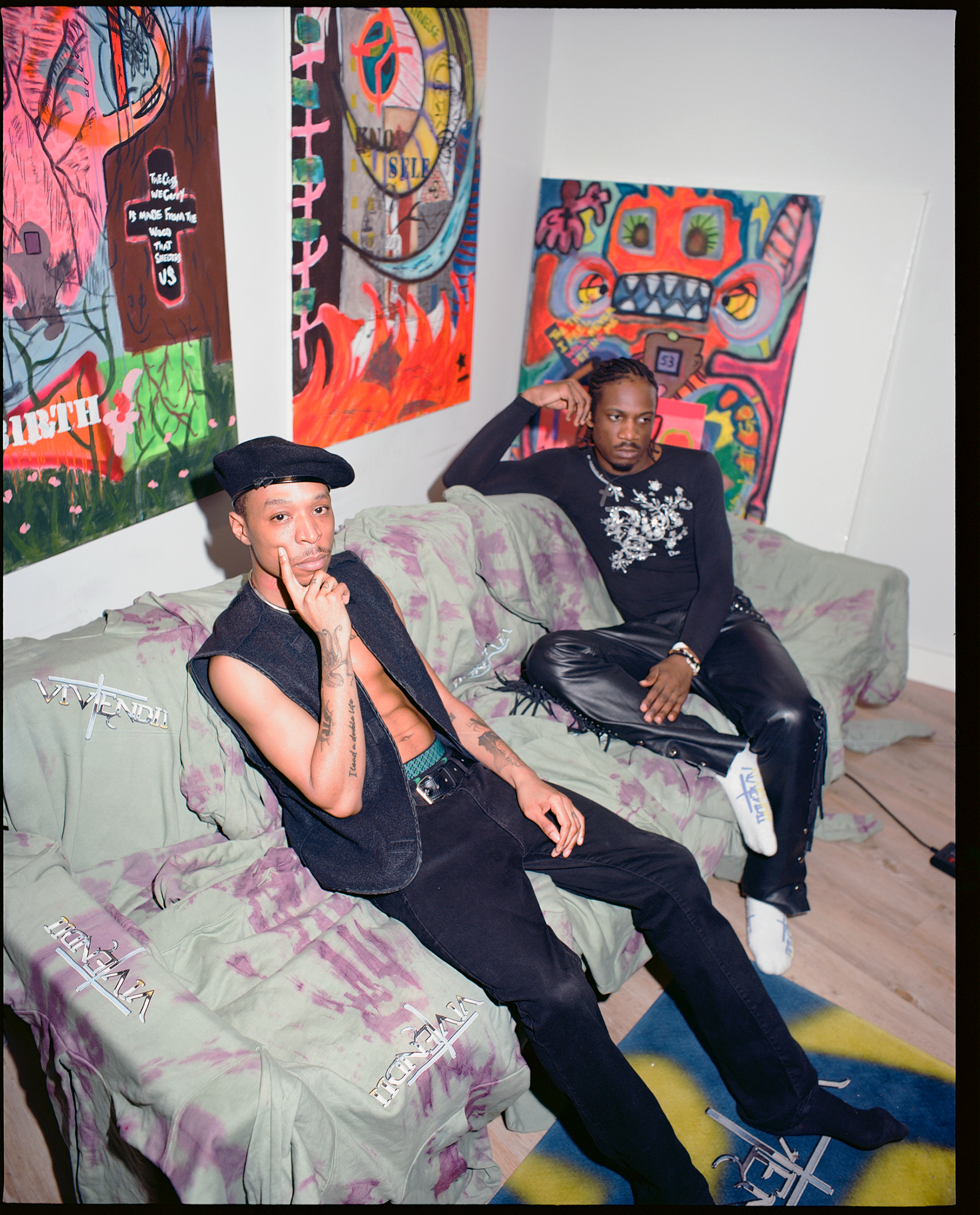
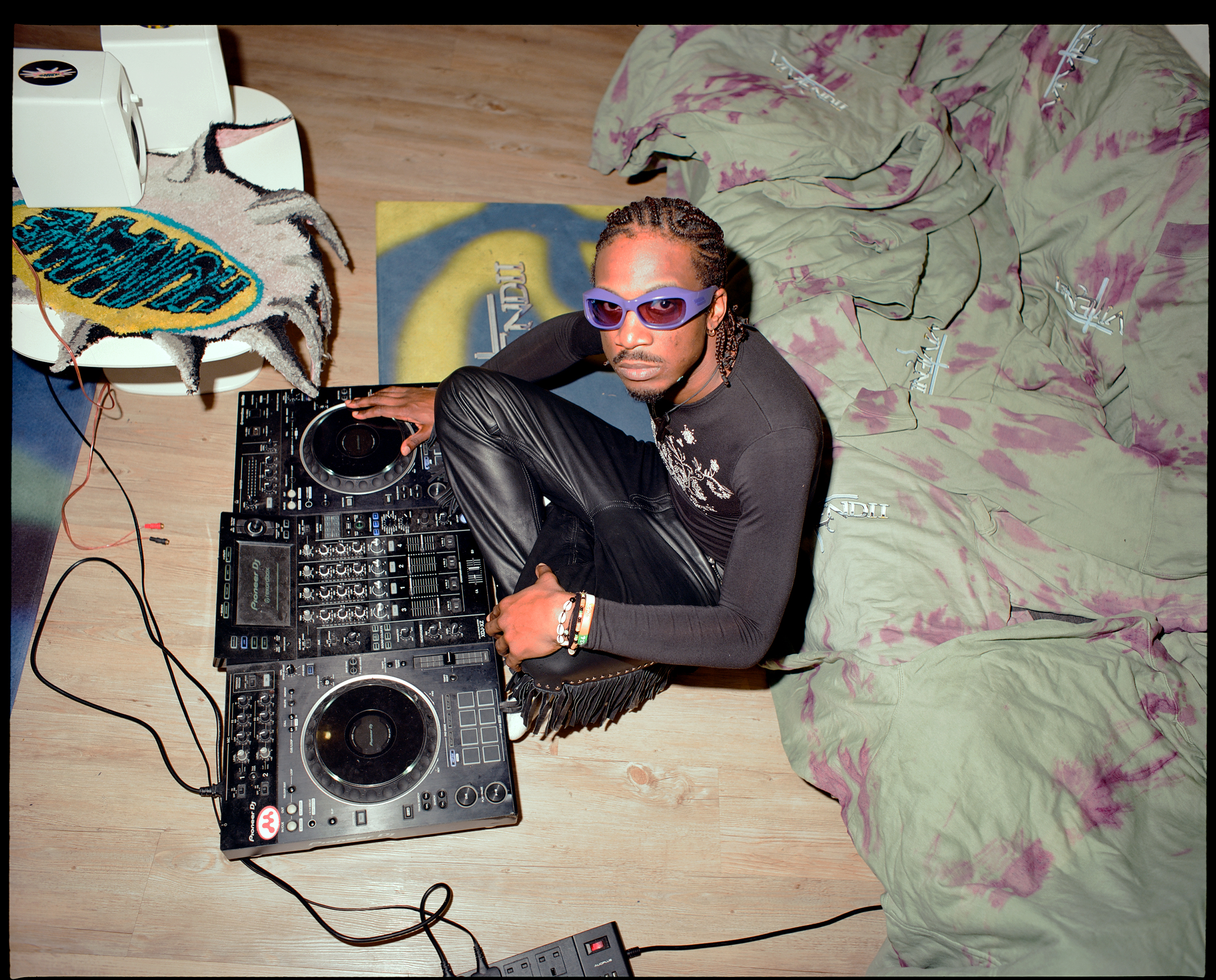
We meet Jimmy Ayeni and Ola Tokunboh Badiru at their east London apartment, which not only serves as a resting ground, but also as a closed-door exhibition. Whilst Jimmy sits by his desktop, mixing sounds and perfecting instrumentals, Ola begins a new painting. It’s almost like a nursery; an incubator for all things creative, true to their brand ‘Vivendii’, which derives from ‘Modus Vivendi’, Latin for ‘our way of living’.
With the Vivendii sound tape coming soon, as screen printed onto a black hoodie worn by Jimmy, we spoke to the duo who are behind the ‘idea’ that Vivendii is, and translates itself through many mediums.
Whether you’re drawn to the soundscapes Jimmy Ayeni has created, or are enticed by the art Ola Tokunboh Badiru is masterfully piecing together, there’s no doubt you’ll stay for the good vibes the two London Lagosians are bringing.
Here we chat with the duo about their individual practices, and how they come together to inform not only Vivendii, but also the role of heritage, youth, collaboration, and community.
How did Vivendii begin?
OTB: Vivendii began as an idea. We were young spirited entrepreneurs, and were into music, art, cartoons, all the hot shows like Beyblade. We've been friends for years, who’ve come together and built like a blog, or like a movement. And we're just like, yo, let's keep pushing this movement. Yeah, we kept pushing an idea. And the idea has developed into a lot of other things. So the idea developed into us making a brand, a clothing brand. People gravitated towards us because of that. But as we both have been growing into so many different things, satisfying our thirst for knowledge, that has led to us becoming like a multifaceted unit, whereby Jimmy does a lot of sound curation, like DJing and all that shit. Putting on shows, he DJs for Pa (Salieu) then I do my art stuff, as well. A mixture of that combined together allows us to interject and work on the clothing more so as well, but we've just developed and gone to a lot of different twists and turns.
What was the journey in becoming somebody creating art, as someone obsessed with visuals at a younger age?
OTB: I've always been fond of imagery. It’s the imagery that draws you in. I was always that kid in Hamleys. I went to Hamleys the other day and realised that I used to pick out toys based on what was most aesthetically pleasing to me. And from then that developed into liking the imagery in cartoons and animations and pictures. And then you learn about history, you get involved in historical art, and then you learn about the significance that that has on the greater world. That kind of pushed me to push myself to express myself in that way. Regardless of if I felt I could or not. It was just like, yo, I'm just gonna do this. I'm just gonna try and in a short time, I started in summer, a lot has come from it.
Do you ever feel like you have to overcome an imposter syndrome, with the art world being notoriously elitist?
OTB: Definitely, definitely, definitely. I had to think about just my expression. So it was more about myself, healing and my personal growth that allowed me to actually start putting stuff on the canvas. It was like therapy to me, I’d subconsciously put stuff on the canvas, and then I would see more about myself; what's going on in my mind. I'm putting that out and other people can resonate with that and relate to other people as well. It’s an amazing, magical feeling.
When starting on a new art piece, are you someone that just goes with the flow, or do you only start once you have that idea in place?
OTB: I feel like my intuition is like God speaking to me. I like to do a bit of both. Balance and duality is one of the most important things. So I like to lead with intuition, but then amongst that time leading into intuition, somehow gain control all of a sudden just to show that I'm doing this, I'm in control. But at the same time, I'm letting the Spirit lead me.
What inspires your aesthetic style?
OTB: The thing is, what inspires me is everything going on around me. Like all artists inspire me, everybody that’s doing something that is taking them out of their comfort zone, that inspires me. A random child’s book author also inspires me. How my imagery reflects? It comes down to the things I've learned growing up, the places I've been, I lived in London until I was 10, 11 then I moved to Nigeria for another 10 years and did my secondary school there. So what you're seeing is an amalgamation of all those experiences, all those colours, you see, the vibrant colours from Nigeria, and you see some of the dull colours from England as well. And all of that fusing together. Somebody described me as a neo-African artist, because you see the African style in the art but, I wasn't intentionally going for that, it's just something that came from within and subconsciously.
Is there a plan to bring all of your different interests into one space?
JA: The curation of sound and DJing for events is more going towards the direction of creating original music. That's something that we've been working on for a couple of months. And also just working on the idea of a musical project that encompasses everything Vivendii is about. Our way of living, this dichotomy between being from back home, and also living abroad and having no real home, but still having where you grew up and what made you a person. So, I think creating original music is a large part of the direction that we want to use to evolve Vivendii Sound. And I've been producing for just a little over a year now. So it's like curating the sound of our generation, alternative sound from Nigeria, while still being able to be appreciated worldwide. I think it's important for us to just tell that story, you know.
Having spent time in Nigeria, do you think that has a heavy influence on the kind of music you're making?
JA: Being brought up in Nigeria, a lot of these sounds can't be underestimated how much of an effect that this has on us as people. But you know, we weren't just knee deep stuck into just what was going on in Nigeria, we were also very tapped into the international scene. And we had MTV and stuff like that we're checking for what’s new and everything. But I think music and sound just play a large part in the childhood of most people I know. Kind of like, an actual directive from even when you're like seven, eight, on how things are. What social cues are, what social pop culture things are.

Ola Tokunboh Badiru

Jimmy Ayeni
What are other influences you have, and how have those inspired your sound?
JA: I feel like some of the best ideas come from struggle with, from not having. Growing up, I think there was a transmission of the standard MTV that used to come to Nigeria, so yeah, absolutely no hip hop, no r&b, no nothing. Growing up, that was one of the few music stations we have. So you'll be forced to tap in some random stuff. You're forced to watch movies and hear some of the songs in movies and hear how that makes you feel. I think from DJing, curating sounds in spaces, you then go on to use that to express yourself as opposed to boxing yourself into what you think people want to hear. I take people through, you know, a roller coaster of emotions, it’s like this record that you know, from when you were a child and you just don't even remember that you remember that song, I just play it for you at this place. And it makes you feel a type of way.
That's kind of the thing that I chase, my natural influences connecting with other people's natural influences. We all kind of grew up on the same thing you know, we're all just kids at home, watching the same cartoons, the same Disney Channel, same this, same that. It's just like tapping into all of that, you realise that we're all one regardless of where we're from, like this new generation we're just all one, we all kind of came up on the same shit, the same sports the same, the same music, same fashion so I really want to just take that to people on a journey, you know. When we play this music, when I produce these songs I want it to feel like something distant but also super at home, you know? Afrobeats, 2000s soft rock, 80s disco and 70s Nigeria funk mixed with like, all this new trap shit that we came up on mixed with me music, you know, it's a big part of everything that inspires us, you know, to create. And that's why these DJ sets are never the same, you know? Yeah, I freestyle every time. It's just supposed to feel like how I feel, how I think you guys are gonna feel and just try and connect to you guys. That's the vibe.
How do you manage the potential conflict between what you want to play and what a crowd might want to hear?
JA: Life is all about balance and I realised that from playing a lot. The original role of the DJ in the industry was to break music directly to the crowds, directly to the people before the labels even knew what single was to go with. Obviously the development of all this streaming shit, Spotify and all these guys curating playlists and stuff, I think that role has kind of changed. But it's also a super fundamental factor in where music is going.There's records that aren't even known on the mainstream wave, but are like double platinum in the streets. I think it's important that there's still people that can curate those ideas because if not, we're just going to be listening to the same shit, same playlist, same top Naija twenty two, rap caviar. There's just so much more depth to what's going on in the scene, I just like to connect with the things that connect with me on an emotional, spiritual, childhood level. I'm very open to many different sounds. And I think if I mix this in a particular way, other people can also be super open to the sounds as well. You know, it's like, I want to turn up, but I want to hear the soundtrack from Shrek, but we're still gonna take it back to some Playboi Carti, but then we still might go straight to Naij. And I think just that juxtaposition of being able to go to different moods, is what I think is the vibe.
Detty December is just around the corner, any plans?
JA: Nigeria really still dictates like, a lot of like our moods of thinking and creating stuff. Sometimes it's just easy at points to dictate the culture from where we are doing our thing in London now, but Nigeria always has a special place in our hearts. And I always go back as much as we can. And our family still lives there, it's our actual home, you know.
OTB: Definitely, we create all the time, we’re constantly creating. We'll do some creating and we'll do some events. I want to do a lot more. Because in the past, we've given back to the community but we want to give back a lot more to the community and potentially build spaces for the youth out there that they can use and feel comfortable to express themselves in creative ways as well. These are projects that we're looking at working on when we get back to Naij.
How important is community to you?
JA: It’s everything you know, it's amazing. There was a point there wasn't even a community, especially back home, you know, it was kind of like very ‘square peg, circle hole’ you know, if you’re a circle peg you can fit in this and if you're not that exact circle peg, you can’t just fit into this whole thing. It's great that people exploring other ideas has allowed a bigger market and a bigger thing to grow for us to be able to share our shit express our shit do what you enjoy in Lagos. Giving back is so important because there’s so many people in Nigeria that we support and just like a very tapped in with, so giving back to our communities is everything.
OTB: Even the community of people that even support us, support our cause. Those who are like minded individuals like us, it's important that we educate them as well. They're the reason why we're where we are today. They've been buying our clothes, they've been coming to our events, you feel me? So it's just giving those people a platform as well to be able to even believe in themselves. Because there's people like that, that made me believe I could do what I'm doing.
How do you navigate your relationship with older members of your community or family, who might not understand what it is you’re creating?
OTB: Well me, I don't really talk to anybody too much about what's going on, if I'm being completely honest with you. Here and there I drop some things but I'm just doing my thing, just living, doing what I want to do in life. I'm not really trying to get anybody's approval from it anymore. I just try to maintain a good relationship with my father at all times, and be good, be a good son. We’ve fought and fallen out in the past, but I've grown up now, and I'm trying to connect and just stay cool with everyone.
JA: Things have just changed now, you know. I think there is definitely evidence going on that this is a more viable thing. I mean, we're obviously at the age where, you know, people only expect serious occupations in Naij. But of course, everything's changing, markets are developing. But I think it's just important for you to just be on your own thing, focusing on things and figure out a plan on how you're trying to do shit, and how it's gonna work.
OTB: Not everybody is going to believe in your shit, you know?
JA: It’s just part of the game, part of the whole game.
There’s a bridge that’s being built between Africa and the UK, especially between London and Lagos. How are you guys helping to bridge that gap?
OTB: You know, in Nigeria, there has been so much brain drain for so many years. You know, a lot of people go out to schools, like we did in the UK, but taking the knowledge and bringing it back to the country and like, setting up centres or infrastructure for the youth, that's what we want people to be doing. Through what we're doing we’re bridging that gap in a way that people are like, ‘Oh, shit, y'all grew up in Lagos. Like what’s popping off in Lagos’. Yeah, like a lot of us, including Deto, including Santi, and the wider community, they're making people think, oh, yeah, I want to go back home. I want to catch a ride back home. And that's very important for us because we want to bring people back home to Africa too.
And lastly, it’s currently a great time to be a Nigerian, but it wasn’t always this way, especially in London, what was your experience of that?
JA: I got here and that was the tone. I couldn’t believe it, I was like, this is crazy. Yeah, I would come here, a few of my cousin's up from there and you know, even they're telling me that about this and I’m just like what is this concept of somebody being you know, like more than someone else you know what I’m saying? So yeah, just to see that completely u-turn from being a bad thing to definitely something good.
Any last words?
JA: Vivendii Sound tape coming soon.
OTB: Watch out for more announcements from all of us.